I.
In the past years, instead of overloading students with the wordy syllabuses I am capable of writing, I have been doing a slow-roll of class rules and exceptions. Like, I suppose, most English teachers, I can easily be unnecessarily longwinded in explaining most anything, which is why the delete key is my word-fighting sidekick. When your life is words on the page, sooner or later your strength becomes your enemy. But here I am doing the thing. Back to it: not leading with the syllabus, it’s a solid move. For one, we can get right down to work. Better than the syllabus, it’s the manner in which we do the work itself that offers more expectation.
And so, last week, I finally got to this year’s spiel about AI. An anecdote came out of me I didn’t expect. I was forming this very essay at the time, in words and in thought. So I had been thinking of trust. And then, in front of the class, the archives of my mind connected some dots and delivered a concept I think I gleaned from reading Malcolm Gladwell’s Talking to Strangers. I talked about how our default nature is to trust. Yes, this might make us suckers, but there are huge psychological and practical costs to being suspicious of every bit of information or action anyone else throws our way.
If you envision a day without such a default mode, you can see how much stress we’d go through. Every little thing would be steeped in distrust. Driving would be a nightmare; walking into my classroom would be fraught; and buying food from anybody would be terrifying. The way were built, with this trust first impulse, is called the Truth-Default Theory:
We do not behave, in other words, like sober-minded scientists, slowly gathering evidence of the truth or falsity of something before reaching a conclusion. We do the opposite. We start by believing. And we stop believing only when our doubts and misgivings rise to the point where we can no longer explain them away. (Gladwell)
I remember in Thailand being amazed that people willingly leave their cars in neutral when they park in certain parking lots. This is done so that people may push cars around to create more space as people free up space when they leave. Perhaps a nuance to that culture, but not to me.
When I switched cars from a tiny but awesome Honda Fit to a F-150 truck, there was a bit of an adjustment. A Honda Fit is almost the polar opposite in regular-person vehicles to an F-150. All the room that I had in the Fit, for parking spaces that is, translated to more room in the cab of my F-150 (I’m a tall man) but less room in a parking space or anywhere else. Therefore, folding in side-mirrors is a thing with a truck. And in the newer trucks, now automatic.
One time, in that new car purchase phase when I was hyper-aware of my new vehicle’s perfection, I sat in my new truck waiting for my wife to return from the post office. A car was parked next to me, on the driver’s side of my truck where I waited. Soon, that car’s owner showed up–a mom with her toddler. I watched the mom open the back door to put her toddler in the carseat. My anxiety ran high, thinking the worst, that she would throw open the car door, bash it into my truck. This was sort of fulfilled–she opened her door wide enough to gently rest her door on my driver’s side truck door while she wrestled her toddler into a car seat. Though my anxiety was getting me good, the door hadn’t really made hard contact, and it looked like the mom had a lot going on. So I said nothing.
I remember when I first realized that one had to be careful when opening a car door in a parking lot. I don’t know how old I was, but I was at least old enough to be a backseat passenger without a carseat. When we arrived at, I think, a McDonald’s, I kicked the door open, per usual, and heard a crunch. The door had made a Mariana Trench in the car next to us. I was terrified; I said nothing about it to anyone.
A decade ago, some teenagers went around my neighborhood and keyed a bunch of cars that were parked on the street.
That night, my car was thankfully parked in my driveway. My neighbor’s car was not.
Whether in the parking lot, in traffic, or at home, dings and scratches are part of the life of every car. All cars, in some way, will be unavoidably clipped, grazed, or blunt-edge-traumaed. Makes me wonder if leaving a car in neutral isn’t so bad. Regardless, we trust each other for the most part out there on the road. And that in itself is a wonder.
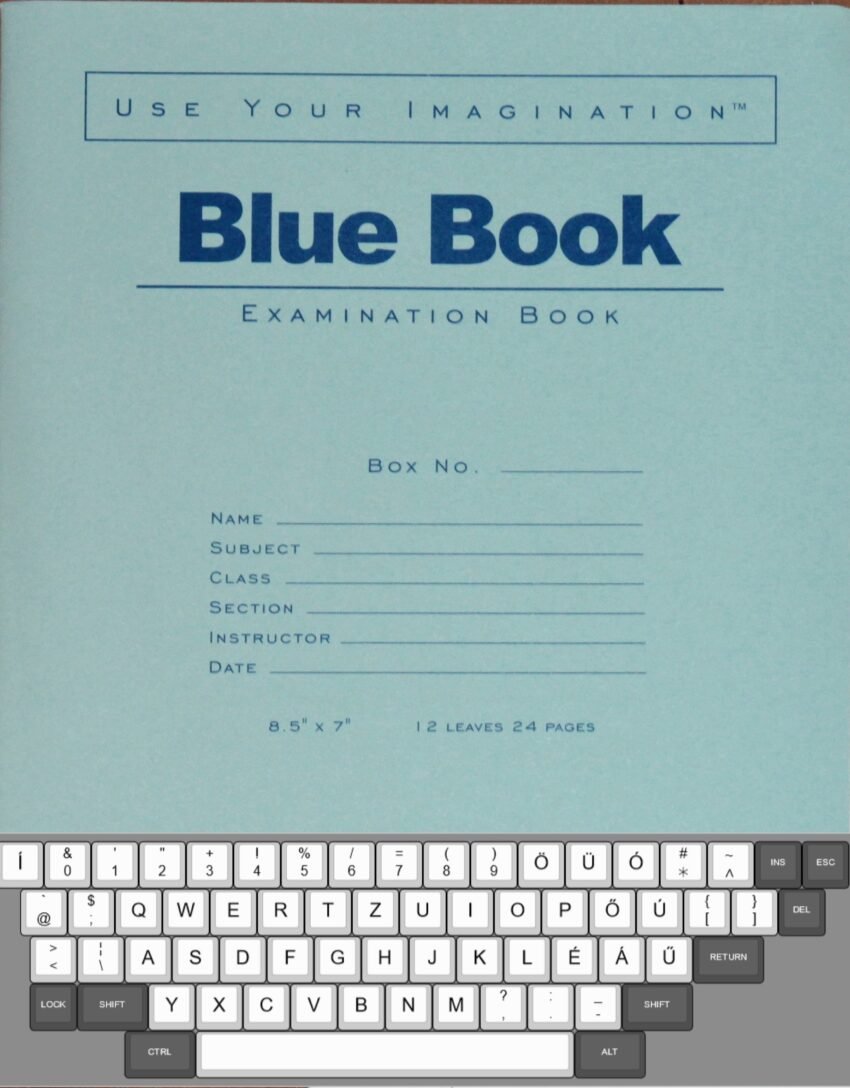
Trust plays out much differently in a classroom. Obviously, the stakes aren’t as high as trusting people in cars to obey traffic laws and be careful of each other, which is probably why we trust the road so much. But unlike the road, trust is dwindling within the classroom. You know the reasons why. And so we are reviving a relic of The Great Gatsby era (or earlier) that so recently got knocked off the classroom supply list. I am talking about the blue book.
One of the myths of the origin of the blue book is that Butler University created blue booksin the late 1920s for written tests. Their name supposedly stems from Butler University’s school colors: blue and white. But this recent Atlantic article disputes that, placing the birth of the blue book somewhere in the mid-19th century. This all doesn’t really matter. What a blue book is suffices– a technology for teachers and professors who do not have ready access to a solid printer or who want a secure format to control.
II.
In the last ten years, standardized tests have adopted a method to sanitize a computer for any types of cheating, locking it down in such a way that cheating is rather impossible. But this buttoned down environment is not readily available to the local classroom written assessments that a blue book is used for. And so we are left with the relative secureness and cheapness of handwriting.
Handwriting, in all its imperfection, lives with us in the material realm. It has links to our oldest habit–manipulating the world. At least in ways that we can understand. I’m sure those who can explain the Rube Goldberg processes of a computer would beg to differ. But though most of us don’t understand the mystery of the digital, we trust it as if it was our autonomic nervous system. (And there’s that word again.) Computers and the internet, like flying in a commercial airplane, have been made robust and reliable, a necessary backbone to the modern age.
But handwriting has used so many writing utensils and canvases that it seems a little crazy to ascribe it such power. Yet, it is now the DIY of the written world. And we cannot deny the power of creativity that works outside the lines.
Neal Stephenson recently responded to some research about how handwriting lights up more of your brain than typing. Stephenson, a masterclass writer of long and complex novels–both in prose and plot–has written all of his work in the last 25 years, except one novel he co-wrote, by hand.
Although handwriting is great and forces meticulousness and slows us down, typing is pretty great too.
As a teacher, I much prefer reading typewritten prose despite the heartwarming nature of a human’s imperfect yet individual impact on paper. I’m not alone. Heck, as an elder millennial, I remember having to type up my handwritten essays (though, in elementary school, are they essays?) on a typewriter. But we know what will happen next in our modern technology land. We are riding a strong wave of hyper-education-tech capitalism. AI software is everywhere, purporting to solve every conceivable problem.
What I’m saying is that we are on the verge of being sold a Faraday-type computer system in the near future–a computer that perhaps brings back the in-house intranet rather than attempting to secure a severely connected Chromebook. In short, a reclamation of the confines of the classroom. And, perhaps, a resurgence of laptop carts, which means we could probably do some salvaging from the ones we just pitched several years ago.
This is not crazy. Chris Osmond lends out a “laptop cart” full of typewriters for his college classes. (I thought a recent blog post about moving his collections of books and typewriters to be quite thoughtful and charming, though I am fairly biased on the book hoarding front.) But then, you know, Faraday computers aren’t going to be the solution. I don’t think even bluebooks will last too long.
This is the thing about edtech, and I guess blue books are a sort of edtech now: they are not structural fixes, nor are they status quo up-enders. They look like both of these things, but in this case, what we are left with is a bunch of dramatic fixes that don’t address the real problem: accountability.
And there we go again, that “trust” word. When we focus on fixing this aspect of education, making sure students do everything themselves, increasing trust in the process, we create another problem, a classroom full of police state values.
This summer, a colleague and I were talking about last year’s exhausting vigilance of maintaining our AI detection faculties in all digital student work and figuring out this year’s solution: what was going to be handwritten and what wasn’t. Both of us had hit our AI detective plagiarism quotient for the year, and we were hoping to not hit that sort of time-consuming, paranoia-inducing, and frustrating wall next year.
What my colleague reminded me was that the assignments that required personal taste or storytelling, these weren’t something we needed to worry too much about. Teenagers want to know who they are, who they will be, and this is an easy lift for English teachers to help them find themselves through their writing. We know the power of it. And what better job can a writing teacher have?
But this can’t be all of school. Learning is never without frustration, otherwise it wouldn’t be learning. If we allow students to just be pure autodidacts, then how will they be pushed in all the directions they need to be pushed to widen their gazes or at least hone their abilities to look out for natural real-life pushes they will need to better themselves?
For instance, it shouldn’t be surprising that video and audio are now the dominant forms of entertainment and information gathering. Reading is foreign to the brain, an unnatural form of communication. It requires a lot of effort.
And that’s the point. Reading gives us superpowers that are constantly proven to be fruitful for our own lives and society in general. It’s an exercise in abstract thinking, a real connector of synapses. The problem in society is that we confuse literacy with having all the benefits of a well-read person. Though the online world has become more video and audio, it is difficult to get by without being able to read.
I often think of Sam Bankman-Fried, the bitcoin dude who is in jail for massive absences of due dilligence, when he was asked about books:
“I would never read a book…. I’m very skeptical of books. I don’t want to say no book is ever worth reading, but I actually do believe something pretty close to that…. I think if you wrote a book, you F**ed up, and it should have been a six-paragraph blog post” (Going Infinite* Lewis)
III.
It is an absolute struggle for me to connect with my teenager self. There is so much I got wrong, so much I got right. And I am yet constantly changing. Every five years, I look at my past in different ways, bringing new vantage points that color the memories of my teenagedom.
For instance, in high school, I used to abhor writing long things with pen or pencil. I remember doing worksheets at home and just wishing that I could type them out and send them to my teachers electronically. It would save me so much time, I thought.
Looking at that version of myself, hand cramping as I laboriously filled out a worksheet, I wonder what I was blind to.
I certainly wasn’t thinking of the content, of going deep into it. Or maybe I was? Maybe I had so many ideas to put down that I was upset that I couldn’t put what I thought was needed as an answer? Or maybe my distaste centered on critiques of perfunctory worksheets, mere homework prattle. I knew the answers, let’s get this over with.
Little did I know back then that this very thing, typing versus longhand, would be studied and debated, teachers discussing the merits of each form of writing in various contexts. One of which is what I’m doing right now.
Last week, I finished a book that a ton of people are talking about: Yesteryear. No spoilers in here or even a summary, but after I was finished, beyond all of the other things I thought about Caro Claire Burke’s book, I wondered why it is that we have such a hard time living in the present. We fetishize so much what the future can be and what the past was that I almost think that all that imagination we had as children didn’t go away but instead got swept into this very adult act of looking forward or behind for our identities, our rationale, our control. When I watch my two-year old play, he rarely thinks of the future or the past. He is pretending this toy truck is not being guided by his hand, but driving itself; this plastic dinosaur is marauding the train tracks strewn across the basement floor; this construction of cardboard, pillows, and blankets is a fort that he can hide in.
What we have now and what we’ve had for a long time is a classroom full of humans with different perspectives. And like all humans, we crave audience–to affirm, to applaud, to feel seen, to not be alone, to tell our stories. Trust lies in there somewhere.
How do we get students to feel really seen, both by who they are and what they are thinking and learning? Well, we need teachers to have enough time to see them.
We can use GoGuardian or a new entrant, Writer’s Lock, or some sort of new hardware, but we will always, in the end, have to trust our students. That’s a gift, to know someone trusts you. You lean into it. Relationships can build such integrity. Adam Grant argued recently that what is needed now more than ever is to teach ethics and morals. He is probably right.
But being taught ethics and morals, to be taught to do what is right, it only goes so far. How can you feel such guiding ethics and morals if you don’t feel the weight of a relationship to others who are affected by them? If a classroom is a crowd, students feel like one of many.
The solution is one that’s always been there. It involves prioritizing the time for teachers to build trust with their students and for students to build trust with their teachers. Minimizing the crowd-ness of the classroom, maximizing time for trust, it is a costly fix, but it might be the most important thing to fix.