When I was fulfilling my philosophy minor in college, it felt like what true college should be: analyzing the world through various lenses and seeing what meaning we could get out of it. Sure, there are plenty of easy jokes about philosophy degrees and professors and whatnot. A philosophy major is easy to dunk on, well, on paper. In terms of practicality, but like a lot of things, the meaning isn’t quite represented by the degree.
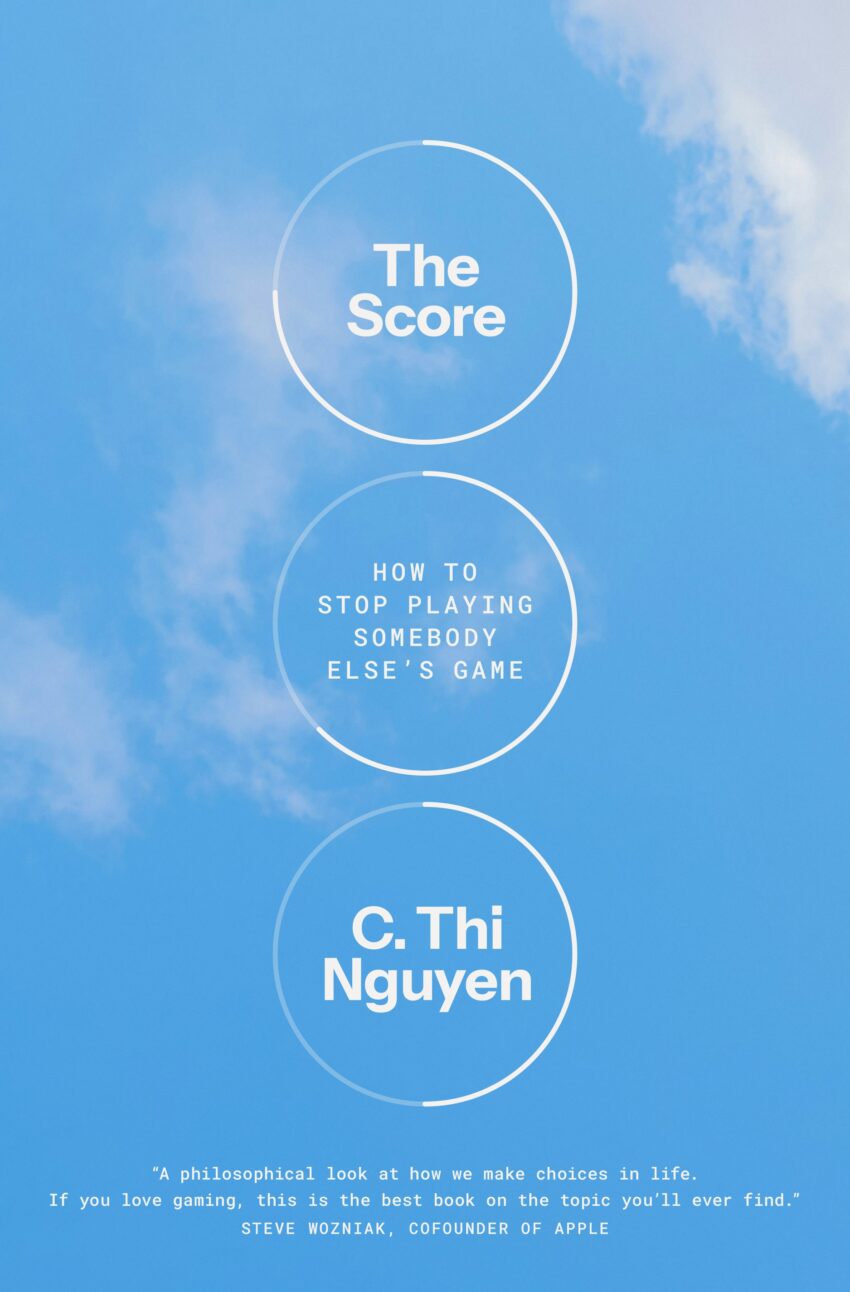
And that’s sort of what C. Thi Nguyen is writing about in his new book The Score.
Nguyen is a philosopher professor, and when you read his prose, you get a bit of a sense of the playfulness of his classroom. Philosophers can be stern and wise, it is true, but we love the ones that look at wisdom with a smile.
Nguyen has been on my radar for a bit though I have yet to read his first book, Games: Agency as Art. But I scrambled to download the first podcast I could to see what the new book was about. That’s when I found myself listening to Pablo Torre Finds Out. The conversation between Torre and Nguyen had to be interesting as Torre is not a philosopher or a gamer but a sports-ish podcaster on The Athletic. And it was. Definitely recommend. The conversation does a splendid job introducing a phrase that is at the root of the book, a phrase that has really revitalized the way I look at the education system as well as my own attempts to make a “gradeless” classroom: “value captured.”
The term, in a sense, Nguyen argues, goes back to Thomas Hobbes:
The politic philosopher Thomas Hobbes thought what ultimately mattered in politics was power. The rightful ruler is whoever has the power to control other people’s actions. But for Hobbes, the true source of power wasn’t strength or military might. He believed that ultimate power comes from the ability to control language and define terms–especially the terms of success. The power over definitions is stronger than military or economic power. Because if you can define what good and evil mean for people, if you can control what success and failure mean for them, then you can control them from the inside.
And though definitions can be written down and logically argued, many of us don’t realize when our values have been replaced by someone else’s. But what has struck me about this simple phrase, “value capture,” is that this definition is liberating, in the sense that just knowing it can explain so much. So let’s define it, or let Nguyen do so: “Value capture occurs when you get your values from some external source and let them rule you without adapting them.”
Seriously though, the term was so ear-perking that as I was listening to Nguyen’s interview on Torre’s podcast on my way to school, I asked Siri to make a note about a new prompt that I was thinking of: “Are you value captured?” But, of course, it’s a silly question. More in the line of: Are you hungry at various junctures in the day? Humans are almost designed to be value captured. It’s only a matter of how much at any given time.
Nguyen uses a really good analogy to explain the phrase. Imagine you are playing a game with your friends or family. You lose. What is your response? Well, if the value of the game was to do something fun with other people, then it was a success. But if you become down in the dumps because you lost the game or because you are worried other people think you are “less than,” then you are value captured. The game has usurped your own values to have fun with a group of people and replaced them with something else.
Then again, everyone is value captured at some point. You have to be in order to play the game. It’s the ability to dip into that space and dip out, back to your prized values that matters.
In education land, the obvious value capture is the grading system. I have been “gradeless” for the better part of a decade now. I’d like to say that my approach has cleared students from being afraid of making mistakes and the like–of not being value captured by grades–but that is certainly not the case.
I still hear this: “Is this for a grade?”
A couple weeks ago, I had a fake argument with my 1st bell about this. I changed my learning plans completely to incorporate a lesson I had scheduled a couple days from then. I wanted them to read an essay a colleague had used for their Independent Reading rollout at the beginning of the year: “An Open Letter to High School Students about Reading” by Patrick Sullivan. It’s now the second semester, and it’s good to check-in, remind ourselves why we are doing the things we are doing in the way that we are doing them.
Independent Reading is something that I have put through the rationale crucible since starting it almost at the beginning of my career. It seems outrageous to stop everything in a 28-person class and read our own books of interest, silently. But the data is pretty clear: Independent Reading provides a much needed safe space for students to set down the rest of their lives and read.
Seems simple enough, but I must convince the students that this is time well spent. That using this time that I have provided is better spent reading than doing homework for other classes. In essence, I am offering a haven where students are forced to deprive themselves of value capture.
Of course, yes, I get that life is busy and that some things are more valued by our society than others. But something that is intrinsic and immaterial can be more difficult to argue than with concrete realities. And my students understand this very clearly. They are teenagers after all and have transitioned from life being more about the present to life being about the future, the tangible future–high school and the preparation for what comes after, the real deal. How does one not become value captured by the metrics that are lauded by “the after”? One can spend time shirking grades for heartfelt extracurriculars, but is that a certainty that a college will understand that? No.
Students aren’t enlightened philosophers. They are teenagers with immature frontal lobes. They excel at being rebels, but the system is ever-looming.
I had one student write to me a couple weeks ago in their reflection of the open letter I mentioned above that if they read the essay at the beginning of the year, they would’ve skimmed it and fake-read-answered the questions. They had found intrinsic value in reading through something as simple as protecting space for it. We need more of that–of persuasion through experience and not the fulfillment of someone else’s values.
But we also need a vast education culture change. Part of the reason why AI is such a boondoggle is because it is showing us the flaws in our system. The question will be whether we value educational change toward intrinsic values like learning and all the intangibles that come with it or value all the efficiencies that have been making our lives easier for decades.
Now I gotta finish the book, which will most assuredly prompt me to write more about it. But I think the most important thing is to keep the conversation going with my colleagues.