Are You Not Entertained Aware of the Allusion You Are Getting Wrong?
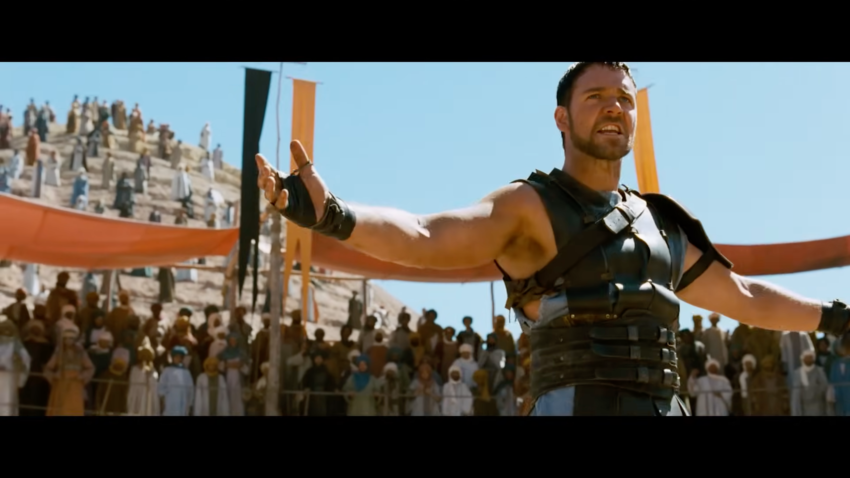
Watching the last games of football of the 2025-2026 season, I have come to understand that Paramount has bought UFC. The commercial that really cemented the sale into my brain is the one with some fiction interspersed amongst the fighters who have been seared into my brain as now familiar like a pre-internet ad jingle. Amongst the hodgepodge of cuts of the fighters UFC, there is a clip of Russell Crow, playing Maximus in Gladiator. And it’s that famous line, “Are you not entertained?” that has caused some cognitive dissonance.
In the context of all of those clips of fighters doing their thing in the ring, Maximus seems to be more circus barker, challenging the audience to just try and not be entertained by the UFC.
But the clip omits what has proceeded the line, the context. And also the fact that Maximus is a fallen general of the Roman army, forced into a violent form of slavery.
Two minutes before the line in question, Maximus is forced to fight five other gladiators at one time. Five versus one. There is no contest. No dramatic climax, no time to feel any sort of tension. And Maximus wins, handedly. In a fury, he throws one of his swords into a box of the rich people.
Then he says the line that’s got him into a UFC commercial (and much more), “Are you not entertained? Are you not entertained? Is this not why you are here?”
Meanwhile, the audience is silent. Maximus throws his second sword down and spits on the floor of the arena. The crowd cheers, but not in the way they are supposed to. Maximus has challenged them, and they have been swayed. They are with him now, not for the bloodlust. But for what he represents. They see him as a human; his leadership shines through.
Well, sort of. I guess. I mean, at least that’s what the movie wants us to believe.
It’s for sure a confusing bit of media to put amongst UFC clips. None of the fighters are without their liberty, their freedom, fighting for their lives. Completely disposable. Maybe psychologically, but not on paper.
Allusions Gone Wrong
I’m sure there are other examples of such allusions losing their context and their meaning. Though I’ve never seen such a glaringly obvious one, the line now meaning its opposite. But stuff like this happens.
Frankenstein is alluded to constantly in a morphed way. We call the monster “Frankenstein” instead of “Frankenstein’s monster.” Which, although incorrect, is kind of true.
Shakespeare has been notoriously misinterpreted: “Wherefore art thou Romeo?” It’s not, “Where art though, Romeo?” Rather, it’s not, “Where are you, Romeo?” It’s, “Why are you Romeo?” In other words, Juliet is mulling over what determines who we are. Do our families define us? Are we just our genetics? What choices do we actually have in who we are?
The gaff seems forgivable, especially since it occurs in the balcony scene. It is night. Juliet has just met Romeo. We all can understand the type of anticipation she now feels at having seen something that she wishes for herself. And Romeo, he is right underneath her, hearing her every word, hiding in the darkness and wondering whether he should reveal himself. They both want to find each other.
But such rationalizations become quite moot due to one of the most famous lines Juliet says in the whole play, appearing not more than ten lines after. It dispels the misinterpretation that can come with “wherefore”: “What’s in a name? That which we call a rose / By any other name would smell as sweet.”
But Gladiator doesn’t live with such classical misinterpretations. It is a movie of “excess,” like Wolf of Wall Street, Fear and Loathing in Las Vegas, Natural Born Killers, Scarface, and Goodfellas. All superbly great movies with an agenda and morals the way we want them. Yet, we are drawn to their glut, even celebrate them despite their problematic nature, live in their worlds, and then we dip out back to our mostly ethical lives. It’s odd sort of satiation.
Perhaps there is relative reverence for big lives. We wish to have some sort of vacation in their world. We play cops and robbers or watch Jason Statham action movies. I mean, Hollywood’s oeuvre is this biggness.
The other day, I finished reading Stephen E. Ambrose’s account of a paratrooper company in World War II, A Band of Brothers. I was struck at how quickly our human bodies are affected by the stress of violence. While telling the story of the famous fight at Bastogne, he quotes a report from an army psychiatrist:
“There is no such thing as ‘getting used to combat. […] Each moment of combat imposes a strain so great that men will break down in direct relation to the intensity and duration of their exposure … psychiatric casualties are as inevitable as gunshot and shrapnel wounds in warfare…. Most men were ineffective after 180 or even 140 days. The general consensus was that a man reached his peak of effectiveness in the first 90 days of combat, that after that his efficiency began to fall off, and that he became steadily less valuable thereafter until he was completely useless.” (203)
Deep down, we all know we are resilient not infinitely so. Or at least our actions and lives are put in check by our own social understanding of harmonious community. It is enough to live through fictional characters for a short stint. In fact, we brag at how much our technologies can immerse us–large caves of screen and speakers, cushy chairs and popcorn (a food that requires inertness and inaction to eat).
UFC, Paramount+, and Maximus, they do fit together, it is true. Gladiator glorifies violence while showing the human element of it. It has its cake and eats it too, though it attempts something drastic in the end to hold its moral footing. Not many freedom movements have existed and come to popularity by killing other enslaved people to gain a noble freedom from their oppressors.
It’s odd that I can link superhero movies like Superman and Wolf of Wall Street. But it’s not odd when you think of fiction’s true purpose–where else to explore bigness on an individual scale?
Besides, real bigness comes with its consequences. Not to say we should pity those who have it better than us. But I’m thinking of Bill Murray’s New York Times interview:
The inability to walk down the street anonymously, how did you figure out how to manage that? It’s a continuous process. It is not like, Oh, I figured that one out, because I’m not the same person now that I was 20 minutes ago. I’m not. You can have a different point of view about it. You can hide from people. I’ve walked down the street with a hat down over my head, glasses on my eyes. I loved Covid.
Because you could disappear? Because I could walk down the street with a mask on my face. It was fantastic. But I’ve been all kinds of ways about it, and it’s a continuing development. I used to spend so much energy. People would say, “Can I take your picture?” And I would be the kind of ass that would say, “It’s ‘May I take your picture?’” Do you know how many times I said that to no avail? Absolutely no avail. But I wasted a whole lot of time that way, doing stuff to make it acceptable on my stupid terms, trying to make life more like I like it. What a screw head. So now what I do for a living is, I take cellphone photographs. I’m not an actor. I am a donkey that is photographed with people who don’t know how to operate their own cellphone camera. That’s what I do all day long. I don’t regret it. I don’t resent it. This is what I do, and it’s so simple, and I’ve realized how much energy I was wasting resisting it. It was just crazy, and when it finally hit me, I went: Oh, my God, what a jerk. How could you have been a jerk for that long? [Murray tears up.]
What I love about this moment is that it is a human dealing with his bigness not in a way that is romantic, but in a way that has all the elements of human emotion and logic: acceptance, understanding, humor, and regret.
Speaking in Fictions
Is it a big deal, this Gladiator gaff? No. Not really. But it reminds me of the power of hype, of pathos in persuasion. Humans have a predisposition to let the celebration of identity–in this case, humans who like to watch people fight–overwhelm their senses. And we have too much of that sort of celebration of identity in the political sphere right now. Instead of playing into it, perhaps our biggest red flags should be when we are being hyped up, especially when the subject is violence.
The one time I actually got to be in the Colosseum, I was gobsmacked by the complexity of such a place–the fact that the floors had levels beneath them or that there were wooden “elevators” everywhere or that there was a large awning for shade for most of the seats. There was so much brutality in such a lauded and quite preserved civilization, comparatively speaking. And that certainly had to be a red flag that things weren’t entirely right.
Today, the colosseum is on our devices. True, we can pull up most any entertainment we want to, but we can also pull up, increasingly, content of the colosseum.
I have this classroom activity that I stole from Carol Jago called a Zoom-In. I really enjoy it, but it’s one of the first things that’s discarded when the year gets too busy. A Zoom-In is about practicing noticing things to find plausible meanings in them. Finding meaning is a natural component of humanity. Our most popular instruction manuals are stories. It is one of the proto ways in which we still learn. We can speak of multiple intelligences and the debunked “learning styles,” but the reality we can never get away from is that humans were built for stories.
But Zoom-Ins are the opposite of apophenia, which is when we see patterns in chaos that are meaningless: a face on an electric socket or a face in the moon or a dinosaur in the clouds. We must have our meaning-making skills to analyze things for true evidence, find stories in them. This will never become a skill we don’t need. Our kind has been doing this since previous iterations of hominids.
When entertainment merges into our real lives, it can be empowering. When people see themselves in characters, it can make them feel finally understood. A true member of society. This is odd, but we are born to be accepted. It’s why we work together so well.
We care about heroes and characters that speak to us. And I think, this is the issue with Maximus being used to promote the UFC, merging a once very prestigious general who has become a slave, a gladiator, in some unfortunate events–though fictional–paired with a sport as closely linked as possible to the nature of the colosseum.
When we use fictional character or real life ones for our own ends, we must be careful we aren’t adding or buying into fictions that don’t serve reality.
Fiction is not anti-nonfiction. It’s another way of looking at what’s around us. It wants to find the truth–we hate fiction that seems contrived. And while it’s fun to pretend magic exists, if we use storytelling to create erroneous ways of looking at reality, it can be harmless and quite consequential.
People say that stories have power, but it’s the humans that give them power, whether it’s the storyteller or the audience themselves.