I.
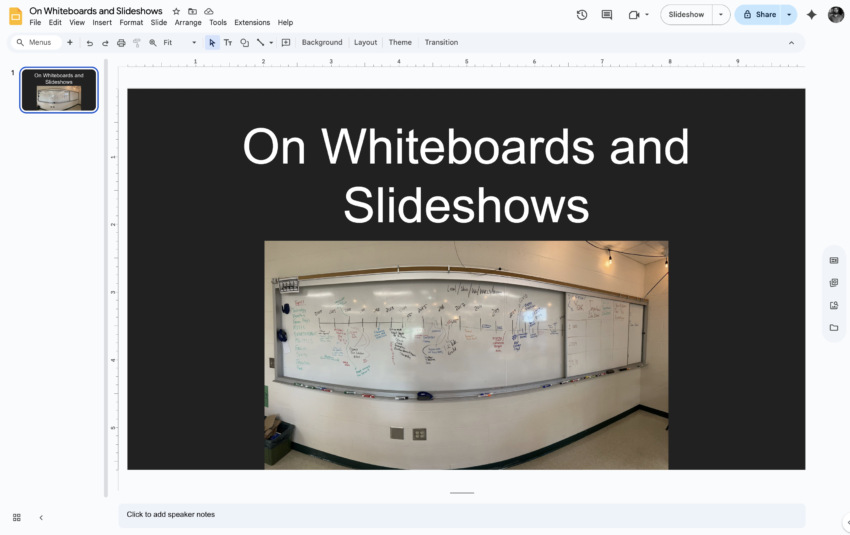
My whiteboard handwriting is pretty good. That is, when I’m not rush-writing example sentences the class needs to work through. Another stipulation: it’s good only if you compare it to my more economical “paper” handwriting. I am a serial switcher between cursive and non-cursive, as if my subconscious thinks its full-on conscious and is yet trying to make up its mind. Such switching, and no doubt my own impatience, makes me like I am in all the rest of the facets of my life: “jack of all trades, master of none.”
But my whiteboard writing, it is like I have made it in the handwriting game. Possibly because there is a mystic to whiteboard handwriting, a low-level kind of specialness we ascribe to topping mountains on the Eastern seaboard or becoming a “C status” celebrity. Though, it’s easily explained. For one, your whole arm is into the motion of whiteboard handwriting. This delivers far better control.
Throughout my school years, many teachers told me that I needed to write more with my arm, which I’ve always had heaps of trouble conceptualizing into neurons tasking muscles to control a pen. I’ve kept pledging to finally acclimate my body to whole-arm penmanship, but it’s always far more expedient not to. I have the same problem with my long-term goal to finally learn how to cut my right foot’s toenails with my left hand. A far less awkward maneuver, but I have never gotten past the initial alien-habit-learning phase required for such a change. It is a motion my right-handed body naturally rebels against. Every time I contort my body–nail clippers in my left hand, right foot ready to be trimmed–I’m like, “I’m a man on the go. Next time.”
On whiteboards, I naturally write with my arm; no rejiggering of the concept of penmanship needed. When we are given space and accept it, we open more of ourselves up. Therefore, whiteboards are vacations from a preferred method of mind-wandering and representation: the notebook. Though not quite the vacation to get away from it all, a whiteboard is far more of a public space than a notebook. This puts some energy into the whiteboard, an opposite to the energy that gives the notebook the privacy to push one’s self without judgment.
The third factor that allows us to loosen up, in public no less, is the supreme erasability factor. You don’t get the smudge you get from pencil marks. On a whiteboard, the eraser glides across a glossy plane, eradicating marks as cleanly as shaking an Etch A Sketch. The internet is the whiteboard’s opposite.
I must say that there is some hedging at my delight at my not-so-sloppy whiteboard handwriting. Unlike chalk, which I often dream of going back to–cantankerous messiness and supreme smell nostalgia–the whiteboard marker is plastic and expensive, even if it is more exact. It seems so wasteful, these huge plastic barrels with far less ink than a simple ballpoint pen. Whiteboard markers should be very easy to recycle, but they are not. They are worse than batteries, though far less dangerous.
I used to worry that using my whiteboard caused a lot more waste than slideshows. I mean, it does, but once I saw how much waste there is in most everything anyone does, especially in art classes, I was like, “Yeah. Never mind.” I’m not sure what kind of human that makes me. Probably a normal one.
A Google search brings me to a ballpark figure of 3,600 feet of writing for every Expo marker, which I have never measured and by default do not believe. However, I do believe a Google search on the Bic Cristal’s writing length: 6,336 feet at minimum. This is prime for economical anxiety, a sort of anxiety that teachers, by dint that they are in this non-lucrative profession, should not have. Therefore, I have a history of hoarding whiteboard markers and Sharpies. I worry that the stockpile is not enough to last us through the winter, let alone the school year. It always lasts, but that feeling of potential ink bankruptcy does not.
II.
At the beginning of this year, I was teaching a class and really making use of the whiteboard. It was obvious that I had shirked that tool for far too long to be considered a good teacher.
This was my umpteenth time realizing this. In fact, I’ve been reminded of this so many times and in so many ways that last year my reminder came from a math professional development book.
I’m a millennial, so things like Google Docs and Google Slides are the norm, even if my generation grew up in a chalkboard world increasingly usurped by whiteboards. Perhaps it was the gradual replacement of technology, a progression perceived only as progress, that created the truth we believed when we got to college, amongst all those projectors projecting digital bips and bops. We thought we’d reached the pinnacle of classroom tech.
We were a part of something as revolutionary as movie theaters to an entertainment industry dominated by the stage, though it was hardly close to that.
Though we’ve advanced presentation and sharing tools, and TED Talks have revitalized the lecture, these past couple of years, and especially now, I’ve noticed that I get bored by teaching with slideshows. (This has been an ongoing thing; I’ve written about it here, which, rereading it, makes me feel worse about my ongoing epiphanies.)
With a slideshow on and the screen rolled down over the middle of my whiteboard, I’m relegated to translating each slide while walking restlessly around the room and then waiting for students to get their thoughts down in their notebooks before I advance to the next slide.
English teachers read a lot of essays, so we all have a lot of in-built patience, but my slideshow wait time is awful. I’d imagine it’s difficult for all teachers: we have limited time; we worry about momentum; and we always have too much to cover, let alone tasks to do in general. This all goes against the optimal conditions for learning, a type of digestion that deserves space.
Slideshows can be super glitzy nowadays, especially with the help of our new AI designer pals. But nothing is more DIY than a whiteboard. That’s ridiculous to say, obviously. A whiteboard is expensive considering it needs certain types of writing utensils. But a flat and erasable plane is a wonderful space for creativity, demonstration, and collective thinking. And, anyway, slideshows take a while to create. And once you create one, it is never finished because the way you teach is always changing either because you are coming up with better pedagogy or your knowledge is changing. If you do not update slideshows, even if you review them before you teach, you forget. You stagnate. You’re on a preset. Your brain leaves the present. Like I said in my previous piece about slideshows, Richard Feynman has the perspective of note:
> When I have the time, I like to sit down and sketch lesson plans in my notebook, drawing them out in all their messiness. I figure out what I know about the topic. This includes the things I knew the last time I taught the lesson and the new things I’ve learned since teaching the lesson. The new knowledge I’ve since acquired is always considerable and sometimes subtle. In essence, I am recreating my lesson and putting it through the grinder. I’m engaging in “deliberate practice.” I have become the student again. I am learning, not simply reviewing. I create new structure; I find new angles and examples; I up my allusion game.
III.
Slideshows can warp presentations in many ways, kind of like how AI can warp the uninitiated writer or even the genius writer that is yet still an error prone human.
Whenever I have my students present slides, I make sure that they do not read of their own slideshow unless there is a quote or some bit of text that is important for everyone to know. Slideshows aren’t documents to read in front of everyone. But it is an easy crutch to do so.
This is another reason I’ve strayed from my own slideshows. My instinct is to always overfill the slideshows with text. It’s innocent: teaching means finding all the ways to communicate a concept and how it works. But overfilling my slides with texts goes against everything I teach to students about presentations. Perhaps this is from adopting online educational tools, all assuaged by the pandemic. If I can prepare students with easily available materials, that seems like a win. In all ways, students will always have access–when they are absent and when they need a review.
But what about the experience of the lesson plan itself? Does the slideshow serve them?
IV.
It is not uncommon for students to commandeer a section of the whiteboard for a message to the teacher or to their fellow students.
This used to be a minor annoyance for me. I erased such innocent graffiti with the style of the Grinch. But students like to leave their mark. They are alive and human. It is what we do. And no matter what comes out on smartphones and Apple Vision Pros, there is something about that physical, if temporary, bit of message that will always feel important: I was here, and you are now here too, and we looked and thought similar things. It’s what’s fascinating about writing in general, perhaps–a link to the past.
But what’s more is that working on a whiteboard is in the genre of manipulation of the world. I’m not sure anyone feels like they are doing that when they are writing on their computers or even in their notebooks. These are personal, individual spaces. When you are doing something, together, on a whiteboard, it’s collective.
There is a small hitch in the “collective” bit: there’s a teacher in the room. If the teacher acts as a fount of information, the collective becomes a bit artificial, the students feeling more like they are on train tracks than on a flight path. It’s when the teacher becomes a hybrid, an unknowing guide, that a whiteboard becomes a conduit for more intentional learning. Just like watching a good movie in a theater full of people, the community gets swept up, far more so than if they were watching the movie at home. Whiteboards have the ability to build knowledge while slideshows thrive on presenting it.
But time ticks, in its various fashions–the slow and spaced seconds of the teenager to the ramped up whole-note-like minutes of an adult. Humans are enamored with efficiency as we are obsessed with aging in general. We are always discounting inefficiency. It makes sense–we try to avoid discomfort, even if getting through it is good for us in the long term. But the point is to find the balance between what has become wise to use and what will become wise to use. That’s hard. A lifelong project.
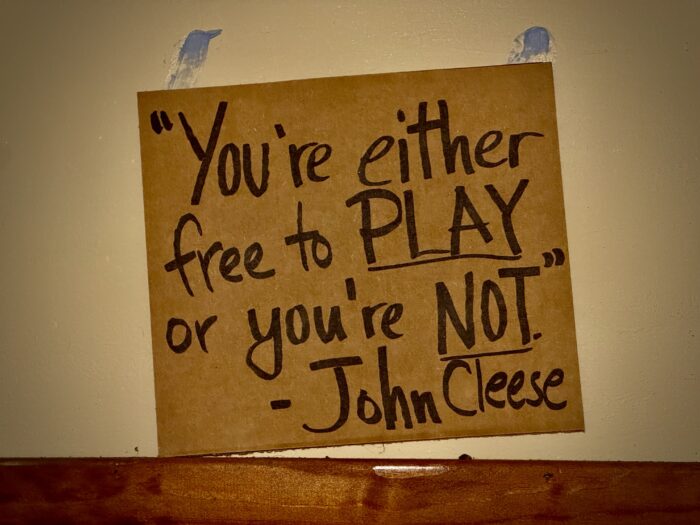
What I’m frequently adhering to more and more is a John Cleese quote about what’s important about creativity: playing. It’s a simple reminder that I have sticky tacked up in my home’s “Artist’s Garett”: “You’re either free to play or you’re not.”
This year, I used my classroom money to install six modest sized Amazon Basic-branded whiteboards in my classroom. It has so far been the best use of classroom funds.
It’s funny. Here is an essay about whiteboards. Ridiculous, right? But here you are, these words in your head. This “technology,” this reading, has a lot in common with slideshows. We are an enrapt audience, ourselves silent as we digest. It is good to work through things independently, to feel that space of non-judgment, creativity unhampered. But there is also that movie theater audience vibe.
If you have ever been to good improv, you have felt what it is like to be in a room where anything can happen. It is a different sort of expectation, one where you are more alert. All our human faculties are at play here, even the dramatic ones. Because there is conflict in working together and getting to the end, whatever that means.